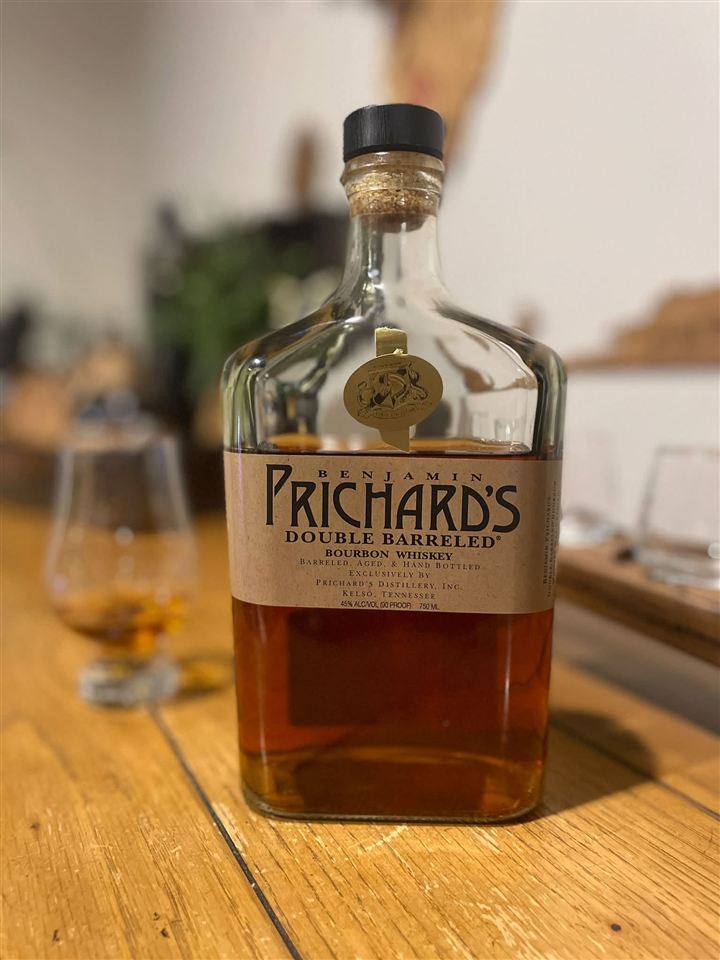
Sometimes I look over my whiskey collection and think, "Today I don’t want anything particularly sweet." I don’t want anything finished in brandy or wine casks. I just want something relatively dry, oak-driven, well-balanced, and straightforward. That’s where Benjamin Prichard’s Double Barreled Bourbon comes into the picture.
It’s interesting how much my whiskey preferences can change from one day to the next. Some days, I crave something rich and sweet. Other days, I want something dry and oak-forward. Then there are days when I’m in the mood for an Irish whiskey, only to change my mind a few minutes later and reach for a Scotch instead. That’s one of the things I enjoy most about whiskey. There’s no single flavor profile that satisfies me every time.
I was anxious to do a review of Benjamin Prichard’s Double Barreled Bourbon because I don't recall seeing many double-barreled bourbons from Tennessee. This one caught my attention and at $63, I figured it was worth giving it a try.
Nose
The nose is relatively mild, especially compared to some of the more aromatic double-oaked bourbons I've experienced. There are hints of caramel and cherry, but neither is particularly pronounced. The oak is present and very pleasant, although it doesn't dominate the experience.
Initally, I was expecting a little more from the nose, considering the additional barrel aging, but it's pleasant enough. There's nothing overly aggressive about it. It's just somewhat reserved.
Palate
This is where things get interesting. The first thing I notice is how much drier this bourbon is compared to most double oaks. Typically, that second barrel contributes additional sweetness, often bringing out richer caramel, vanilla, brown sugar, and toasted wood notes. Prichard's takes a different direction. The oak is more prominent, while the sweetness stays in the background. There's enough caramel character to keep things interesting, but this certainly isn't one of those dessert-like double-oaked bourbons.
What I appreciate is that the oak doesn't come across as charred or bitter. The extra barrel aging makes this taste more like a good 15-year bourbon. I've had plenty of heavily oaked whiskeys where the wood influence becomes unpleasant, but this bourbon is just the opposite.
It's also a bourbon that grows on you. My initial impression was that it was decent but nothing particularly special. However, the more time I spend with it, the more I appreciate what it's offering. To appreciate the richer caramel, vanilla, and brown sugar notes, you need to linger with this. I linger, and as a result, this has become one of my favorite bourbons when I am looking for something a little dry, aged, and oak-driven.
One other thing I noticed is the absence of that distinctive charcoal-filtered character I sometimes pick up in Tennessee whiskeys. After some research, I discovered that it does not undergo the Lincoln County Process, even though the distillery is located in Lincoln County. They were essentially grandfathered in and allowed to call it Tennessee whiskey.
Finish
The finish stays consistent with the palate, leaning toward dry oak rather than lingering sweetness. There's no big rush of caramel or vanilla at the end, which is something I've come to expect from many double-barreled bourbons. It's relatively straightforward, and I don't have a problem with that. Not every whiskey needs an elaborate finish to be enjoyable.
Overall
Benjamin Prichard’s Double Barreled Bourbon is a surprisingly good bourbon, particularly if you're looking for something a little different from the typical double oak. I enjoy sweeter bourbons as much as anyone, but there are times when I simply don't want that flavor profile. Sometimes I want to taste the oak without having it buried beneath layers of caramel, brown sugar, and vanilla. This bourbon fills that role nicely.
Would I recommend it to someone who loves the rich sweetness of Old Forester 1910 or other dessert-like double oaks? Maybe not. At least not without explaining that Prichard's offers a noticeably different experience. However, if you appreciate drier, aged, oak-forward bourbons like Calumet 15 Year or Sam Houston 15 Year, I think you'll find something to like here.
One thing I can say with certainty is that it comes in a beautiful bottle. And at $63, I'm not mad about the purchase. However, I have seen the prices upwards of $110.
Benjamin Prichard’s Double Barreled Bourbon is a very, very good whiskey.